|
|
|
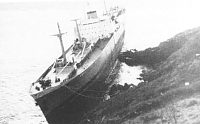
The name of Costa da Morte (Coast of Death) has two possible origins: its rough sea (shipwrecks), and its sunsets (the dying sun). The historical name of the region until the 18th century is Celtic cape (Celticum prom). Costa da Morte is between 42º 45' and 43º 25' latitude degrees. It is surrounded by the Atlantic Ocean on the north and in the west, by the regions of Corunna and Santiago on the east, and by Barbanza on the south. Main rivers are Anllons, Xallas, Grande e Castro. Highest summits are Montes da Runa (646 m.) Monte Pindo (629 m.), Monte Santa Barbara (538) and Monte Neme (386 m.). World wide known Costa da morte's capes are Cape Fisterra, Cape Tourinan, Cape Vilan, Cape Roncudo and Cape Santo Hadrian. CLIMATE Gulf Stream causes warm temperatures in summer (17.5 ºC in June) and mild weather in winter (7.5 ºC in January). Rain is less frecuent than in the rest of Galicia (Camarinas and Muxia, 800-1000 mm, and Fisterra, 600-800 mm). First land in Europe receiving the north depressions, Costa da Morte's skyes are considered to be one of the most spectacular in the world. ECONOMY Fishing and cattle are the main activities in the region. Malpica and Camarinas are the most active ports (5000 to 6000 tn. of fish per year). Other important ports are Caion, Corcubion, Fisterra, Laxe, Corme, Muxia and Camelle. Belonging to the eurosiberian flora area, forest landscape in Costa da Morte has been changing since the beginning of the century from oak woods to eucalyptus, which is used for timber. Costa da Morte is the base of a large number of enterprises due to its strategic situation between Corunna and Santiago. Tourism is becoming a growing and popular industry in the area. HISTORY The Land's End is populated since 1300 b.C. by the Celtic tuath of the Nerium. Costa da Morte was the homeland of the Trabas, the most important clan of the Kingdom of Galicia. Later on, the Moscosos inherited their territories. The medieval period meant prosperity and freedom for Galicia due to the cultural and political preponderance of the Kingdom, which held intense commercial relationships with all Europe. After the Irmandinhos' civil wars, Castile took advantage of a very weak Kingdom of Galicia and annexed it in the XV century. The Land's End suffered then the consequences of Spanish wars, trade with America and Europe was forbidden, and galician culture was censored. Since the beginning of the XIX century, Galician national identity was supported by men and women in Costa da Morte, becoming many of them a symbol for the Galician people like Alfredo Branas, Eduardo Pondal or Lopez Abente. SHIPWRECKS
POPULATION AND LANGUAGE Both place names and dialect spoken in Costa da Morte are quite influenced by the ancient Galician Celtic language. Costa da Morte's accent is very rich and melodious -specially in the areas of Xallas and Soneira- and can be compared to the Galician of the north of Portugal. Spanish
language is widely spoken and understood by the population. Other languages
spoken in the region are French, German, and English.
BY CAR AND BY TRAIN Main gateways to Costa da Morte come from Corunna (motorway Corunna-Carballo A-55 and Comarcal Corunna-Fisterra 552) and from Santiago (Comarcal Santiago-Fisterra 550, and Comarcal Santiago-Baio 545). Public transport in Costa da Morte is managed by Autocares Finisterre, tel : +34 981 226 395. Main towns in Costa da Morte have got Taxi. Nearest train stations are Santiago de Compostela +34 981 520 202 and Corunna +34 981 150 202. BY SEA There are 14 well equiped ports in Costa da Morte : Barizo, Caion, Camarinas, Camelle, Cee, Corcubion, Corme, Fisterra, Laxe, Malpica, Muros, Muxia, O Pindo and Portocubelo. BY AIR Nearest
airports are Aeroporto Internacional de Lavacolla +34 981 597 400, providing
flights with Buenos Aires, New York, Frankfurt, Geneve, Zurich, Paris,
Brussels, London, and the main cities in the European and American continent.
Aeroporto de Alvedro in Corunna +34 981 187 200 has gotten connections
with Paris, Madrid, London and Barcelona.
|